Author: Site Editor Publish Time: 2026-10-13 Origin: Site


StruCell P45 is documented at 48 kg/m³, showing why the number in a grade name is not always its measured density. P130 has a documented 120–150 kg/m³ range. Ask for the current range and acceptance procedure rather than imposing an invented universal tolerance. Record actual lot information when density is important to the part’s mass budget.
For a plain untrimmed panel, mass equals density multiplied by area and thickness. An illustrative 1 m² core at 20 mm thickness has volume 0.02 m³. At 80 kg/m³ it weighs 1.6 kg; at 100 kg/m³ it weighs 2.0 kg. These calculated values exclude faces, adhesive, grooves, resin uptake and local reinforcements, so they are not finished-panel weights.
The documented P80 shear strength is 1.15 MPa, P100 is 1.44 MPa and P130 is 2.1 MPa. Keep these exact values instead of rounding them into unsupported higher numbers. The responsible design process must address test methods, variability, environment and failure modes before establishing an allowable for a particular structure.
A panel can meet a global bending target while failing near a fastener or support. Core density is only one part of that detail. Consider engineered inserts, load spreading, face reinforcement and edge close-outs. A high-density foam block is not automatically an approved fastener attachment, and local changes need a reviewed transition into the surrounding sandwich.
Density is mass per unit volume, normally expressed in kg/m³ for structural foam. It is an important input to weight calculations, but it does not independently determine every mechanical or processing property. Specify the actual grade, measured range and test information alongside density.
Higher density means more material in each cubic metre, which makes the foam heavier, stiffer and stronger, and also more expensive. Lower density means a lighter, more economical foam, but one with correspondingly less strength and stiffness.
Understanding this relationship is the foundation of all core selection. Once you know the density you need, the rest of the specification — grade, cell size, finish — becomes much easier to settle.
Density sits at the centre of a three-way trade-off between strength, weight and cost. Increasing density raises strength and stiffness, but it also raises weight and cost. Decreasing density does the opposite.
Selection seeks a construction that meets all structural, processing and environmental requirements at acceptable installed weight and cost. The lowest dry core density is not automatically the cheapest or lightest finished design. Account for skins, reinforcement, resin uptake and local details when comparing candidates.
In practice, this means starting from the loads the core must carry and the deflection limits the part must meet, and then working backward to the density that satisfies both requirements.
The documented StruCell series includes P45 at 48 kg/m³, then P60, P80, P100, P130, P200 and P250. P300 has a documented density range of 290–330 kg/m³. Grade names identify products; they are not always exact measured densities or universal application prescriptions.
Use the documented grade table to screen candidates, then evaluate the load case and manufacturing environment. Low density does not mean a material is necessarily non-structural, and a higher-density label does not automatically qualify a hard point. Complete the strength, deflection, local-load and processing review for the intended construction.
The table below summarises the common density ranges and their typical uses.
| Grade | Density (kg/m³) | Compressive strength (MPa) | Shear strength (MPa) |
|---|---|---|---|
| P45 | 48 | 0.6 | 0.5 |
| P60 | 60 | 0.93 | 0.76 |
| P80 | 80 | 1.4 | 1.15 |
| P100 | 100 | 2.0 | 1.44 |
| P130 | 130 | 3.0 | 2.1 |
| P200 | 200 | 4.8 | 3.5 |
| P250 | 250 | 6.2 | 4.0 |
Source: documented StruCell series specifications in the site knowledge base. Confirm current test methods and whether values are typical or minimum; these are not structural design allowables. P130 density range is 120–150 kg/m³.
Marine density selection depends on spans, loading, face sheets, impact and local details. P80 and P100 may be evaluated as candidates, but no density range is prescribed for every hull or deck. Confirm the grade and construction through the applicable design and qualification process.
Highly loaded areas, such as transoms, engine beds and through-hull fittings, use higher-density foam or additional reinforcement, because these areas must carry concentrated loads.
For marine cores, low water absorption is essential, which is why a foam core for boat building made from closed-cell PVC foam is the standard choice, regardless of the density selected.
Wind blade density selection must address the actual laminate, fatigue programme and local load paths. The application name cannot establish a shell or root density. Review the complete engineering specification and candidate grade evidence; do not treat generic ranges as approved blade design guidance.
The fatigue performance of the foam is directly related to its density, so designers specify the minimum density that still meets the fatigue requirements, keeping the blade as light as possible overall.
Because wind blades are very large structures and the core represents a significant fraction of the total weight, even a small density reduction can save a meaningful amount of mass across the entire blade.
Industrial panels, truck bodies, rail interiors and similar applications typically use mid-density foam, because the priority is a balance of strength, insulation and cost rather than minimum weight.
For these applications, density is often driven by the need to meet impact resistance and fastener holding requirements, as well as the stiffness needed to span between supports.
Higher-density foam is used where fasteners or hard points must be anchored, or where the panel must resist localised impact without denting.
Resin uptake depends on surface cells, machining, grooves, perforations and the resin process as well as formulation. Do not infer a universal cell size or uptake value from density alone. Weigh representative panels and include resin in processing features when comparing installed mass.
This means the weight of the finished laminate depends on both the foam density and the resin uptake, and the two must be considered together when comparing options.
For this reason, many marine and wind builders prefer foam with a fine, uniform cell structure, which keeps resin uptake predictable and minimises hidden weight.
When selecting density, the datasheet provides the values you need: nominal density, compressive strength, shear strength, shear modulus and water absorption. These values are reported per grade, so you can compare grades directly.
Always check the test standard used for each value, because strength values can differ depending on how they were measured. Comparing values from different standards can be misleading.
The compressive and shear strengths are the most important for sandwich design, because these are the primary loads the core carries. The datasheet lets you match these values to your structural requirements.
Sandwich design uses simple rules to size a core. The core must be thick enough to carry the shear load and stiff enough to prevent the faces from buckling, and the density must be high enough to provide the required shear strength for the application.
A common starting point is to calculate the required shear strength from the applied loads, then select the lowest density whose datasheet shear strength comfortably exceeds that value with an appropriate safety factor applied for the specific application.
This gives a defensible, engineering-based density selection, rather than a guess, and it is the approach used in professional composite design.
| Illustrative 1 m² core | Thickness | Calculated dry mass |
|---|---|---|
| P80 at 80 kg/m³ | 20 mm | 1.6 kg |
| P100 at 100 kg/m³ | 20 mm | 2.0 kg |
| P130 at nominal 130 kg/m³ | 20 mm | 2.6 kg |
Calculated example: mass = density × area × thickness. Excludes skins, adhesive, resin uptake and local details.
Safety factors account for uncertainty in loads, material properties and workmanship. In sandwich design, the core strength is typically reduced by a safety factor before it is compared with the applied load.
The size of the safety factor depends on the application. Highly safety-critical structures use larger factors, while less critical, well-understood applications may use smaller factors without concern.
Required properties and safety factors must follow the applicable engineering design basis. Density does not rise directly or linearly with a safety factor, and typical strength data are not automatic allowables. Include variability, exposure and the relevant failure modes in the responsible designer’s calculations.
Density also influences surface finish and cell size. Higher-density foams generally have a finer, more uniform cell structure and a smoother surface, which reduces resin uptake and improves the finish of the laminate.
Lower-density foams may have a coarser surface that requires somewhat more resin to seal, though modern manufacturing techniques produce low-density foams with good surface quality too.
For cosmetic surfaces, a fine-cell, higher-density foam or a foam with a pre-finished surface can substantially reduce the finishing work required.
Fire classifications are specific to grade, thickness, test method and report scope. The portfolio does not establish that every density is available with equivalent fire performance. Request the exact report and assess the finished laminate’s applicable requirement separately.
A flammability classification does not by itself establish smoke, toxicity or full transport-panel compliance. Do not infer these properties from the presence of a fire-retardant designation. Use the exact test reports and the applicable completed-part standard when preparing a specification.
If fire performance is required, select a documented grade and thickness and review its mechanical and processing properties again. Equivalent density does not prove equivalent performance after a formulation change. Obtain the report scope and validate the complete panel required by the project.
Cost rises with density, because higher-density foam contains more material. However, the relationship is not simply linear, and the total cost must also account for resin uptake, processing time and scrap.
In many cases, a slightly higher-density foam can actually be more economical overall, because it absorbs less resin and produces a cleaner, more predictable and consistent laminate.
The best approach is to compare the total installed cost — foam plus resin plus labour and any rework — across the density options, rather than comparing the foam price alone.
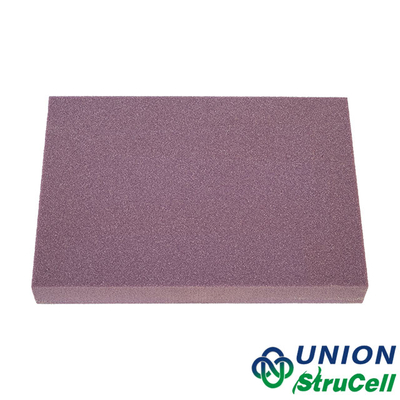
Product photograph: StruCell P45 structural PVC foam core. The pictured surface configuration is illustrative; confirm grade, dimensions and finish for the selected manufacturing process.

Product photograph: StruCell P130 structural PVC foam core. The pictured surface configuration is illustrative; confirm grade, dimensions and finish for the selected manufacturing process.
The most common mistake is choosing a density that is too low to meet the loads, which leads to core failure, delamination or excessive deflection. This is usually the result of guessing rather than calculating.
The opposite mistake — choosing a density that is far too high — produces an overweight, over-cost part that offers no additional structural benefit. This is often done out of caution, but it simply wastes weight and money.
A third common mistake is ignoring resin uptake when comparing densities. A low-density foam that soaks up resin may end up heavier and more expensive than a higher-density foam with low uptake.
Even with careful calculation, it is wise to test the selected density in your own process before committing to production. Build a representative test panel, check the laminate weight and inspect the bond, and verify that the finished part meets its strength and deflection targets.
Testing also reveals process issues — resin uptake, surface finish, machining behaviour — that datasheets alone cannot predict. A small amount of testing up front can prevent costly problems in production.
For high-volume programmes, this testing is part of the process qualification, and it provides the documented evidence needed to justify the density you have chosen.
A knowledgeable core foam manufacturer can help you select the right density by reviewing your loads and application and recommending a grade. This guidance is especially valuable when you are new to sandwich design.
Suppliers can also provide samples across a density range, so you can test the trade-offs yourself before deciding. This hands-on comparison is often the fastest way to a confident choice.
ISO 845:2006 defines measurement of apparent overall density and apparent core density for cellular plastics and rubbers. A grade designation is therefore not a substitute for a stated density measurement.
ASTM C273/C273M addresses shear properties of sandwich core materials. Compare results using the stated specimen, preparation and test conditions rather than inferring shear performance from density alone.
Choosing density means evaluating documented grade properties against a complete requirement. A candidate must satisfy global and local loads, deflection, processing and exposure, not just one strength comparison. Installed weight and cost require the complete construction to be included.
Start from the loads, use the datasheet shear strength to select a grade with an appropriate safety factor, and account for resin uptake and total cost. Then test the choice in your own process.
Start density selection from loads, spans, faces, local details and cure conditions, then shortlist documented grades. There is no universal 80–100 kg/m³ default for most projects. Record which requirements each candidate satisfies and which still need confirmation before purchasing production material.
Foam density is measured by weighing a precisely dimensioned sample and dividing its mass by its volume, giving a value in kg/m³. This measurement is standardised, so densities reported by different suppliers can be compared directly.
Reputable foam manufacturers control density tightly during production, holding each grade within a narrow tolerance around its nominal value. This consistency is essential, because density directly affects strength and weight.
When specifying foam, use the nominal density and confirm the tolerance with the supplier, so you know exactly how much variation to expect in production.
Density and stiffness are closely linked. As density rises, the foam's compressive and shear moduli rise as well, making the core stiffer and better able to resist the bending loads in a sandwich panel.
This relationship is roughly linear over the practical density range, which means a core that is twice as dense is roughly twice as stiff and twice as strong, though the exact ratio varies somewhat with the specific foam formulation.
For a sandwich panel, a stiffer core allows the face sheets to work more efficiently, increasing the overall stiffness of the panel for a given weight. This is why density is the primary lever in core selection.
The same density principles apply to sports equipment cores, though the numbers are different. A pickleball paddle core, for example, uses a relatively low density to keep the paddle light, with the density tuned to achieve the target weight and feel.
For these applications, density is chosen primarily for weight and feel, rather than for structural load-carrying, because the loads on a paddle are modest compared with a boat hull or wind blade.
The ability to specify foam in fine density increments is valuable here, because it lets designers hit a precise weight target while keeping the responsive feel that players demand.
Density affects how foam thermoforms. Higher-density foam is stiffer and requires more heat and force to shape, while lower-density foam forms more easily but is more delicate.
Thermoforming capability depends on the formulation, thickness, heating history and geometry, not merely a mid-density label. Obtain the supplier’s forming procedure and verify dimensions and properties after forming. Grooved, contour-cut or CNC-shaped cores may be alternatives where an appropriate heating window is not available.
If you plan to thermoform the core, confirm with the supplier that the density you select is suitable for your forming process and geometry.
Density also influences machining behaviour. Higher-density foam machines more cleanly and holds finer detail, while lower-density foam cuts more easily but can tear or crumble if the tooling is not sharp.
For parts with tight tolerances or fine features, a higher-density foam is often easier to machine accurately, even if it costs a little more.
In practice, CNC machining of PVC foam is straightforward across the density range, and a good machinist can achieve excellent results at any density with the right feeds and speeds.
The service environment can influence density choice. In wet environments, water resistance matters as much as strength, and closed-cell PVC foam is chosen for its very low water absorption, regardless of density.
In high-temperature or fire-sensitive environments, the choice may be constrained to fire-retardant grades, which are available across the density range.
By considering the environment alongside the loads, you can avoid selecting a density that is structurally adequate but environmentally unsuitable.
To summarise the selection process, here is a checklist you can follow. It brings together the load, environmental, process and cost factors into a simple sequence.
First, calculate the required shear strength from your loads, and note the deflection limits the part must meet. Second, note any environmental constraints, such as water exposure or fire requirements. Third, note your processing method and any thermoforming or machining needs.
Fourth, select the lowest density whose datasheet strength meets your requirements with a safety factor, and that is compatible with your environment and process. Fifth, compare total installed cost across the shortlist. Finally, test the choice in your own process before production.
Following this checklist gives you a defensible, engineering-based density selection, and it avoids the two most common mistakes: choosing too low a density out of a focus on weight, or too high a density out of caution.
The core is only one part of the structure, and its density should be chosen in the context of the whole panel. A lighter core can sometimes be used with slightly thicker face sheets to achieve exactly the same overall stiffness at a lower total weight.
Conversely, a denser core can allow thinner face sheets, because the stiffer core keeps the faces working efficiently. These trade-offs mean the core density and the face sheet design should be optimised together, not independently of one another.
A holistic approach to sandwich design, considering core and faces together, often finds a lighter or cheaper combination than optimising either part in complete isolation.
If you need to reduce weight but cannot reduce density for structural reasons, there are still options. One is to use a thinner core with stiffer face sheets, which shifts the load-carrying to the faces. Another is to use a grooved or perforated core, which removes material where it is not needed.
Careful design can also remove core material in low-stress regions while retaining the density needed in high-stress areas. This selective approach keeps the weight down without compromising strength.
These techniques require more design effort, but they are standard practice in weight-critical industries such as wind energy and aerospace.
PVC foam was introduced to composite construction in the mid-twentieth century, initially in a limited range of densities. As applications diversified, manufacturers developed a wider range of grades to serve everything from light-duty panels to heavy structural cores.
This expansion of density grades mirrored the growth of sandwich construction itself, from early marine applications into wind energy, transportation and industrial panels. Today, a designer can choose from a continuous series of densities, each optimised for a specific class of loads.
The availability of fine density increments is a major advantage of PVC foam, because it lets designers hit precise weight and strength targets that would be difficult with coarser material options.
Lower-density foams are better thermal insulators, because they contain more trapped air per unit volume, and air is a poor conductor of heat. This makes low-density PVC foam useful in applications where insulation matters, such as cold storage and refrigerated transport.
However, in most sandwich structures, the core is chosen for structural performance rather than insulation, and the insulation benefit of lower density is a secondary consideration.
For applications that need both strength and insulation, a mid-density foam offers a workable compromise, providing structural performance while retaining some insulating value.
Other core materials need their own grade and test information. Density alone cannot establish equivalent stiffness-to-weight or moisture behaviour across foam and wood architectures. Compare both controlled coupons and complete constructions that satisfy the same structural requirement.
PVC and PET products are not interchangeable merely because their nominal densities match. Mechanical, thermal, surface and bond behaviour must be reviewed. A substitution needs comparable grade data and process qualification, including any changes in installed mass or environmental documentation.
Honeycomb cores are much lighter for their stiffness but present different bonding and edge-finish challenges. This comparison helps you understand where PVC foam density sits in the broader landscape of core materials.
Specifying density correctly on a purchase order avoids confusion and ensures you receive the right material. State the nominal density in kg/m³, the required tolerance, and any grade or finish requirements, along with the sheet dimensions and quantity.
For a purchase specification, identify the grade, agreed density range, thickness, dimensions and surface configuration using the current supplier documentation. For example, P130 has a documented density range of 120–150 kg/m³. This does not establish a generic ±5% tolerance for all grades or arbitrary sheet dimensions.
If the foam will be machined or thermoformed, note that on the order too, so the supplier can advise on the best grade for the process. Clear specification up front prevents the most common sourcing problems.
Density acceptance must come from the current grade specification and purchase agreement. Sampling, conditioning and measurement methods also matter. A nominal label and an unspecified tolerance are insufficient for material acceptance; retain the lot identification and agreed inspection record.
Do not apply a blanket ±5% density tolerance to every StruCell product. The documented P130 range is 120–150 kg/m³, and other grades require their own current acceptance values. Request the actual range and test procedure before assigning a tighter purchasing limit.
A supplier that documents density tolerance and provides batch traceability gives you confidence that every sheet will perform exactly as specified, which is essential for repeatable production.
The edges of a sandwich panel are often closed out with adhesive or a solid insert, and the core density affects how this is done. A denser core provides a firmer substrate for edge close-out and can hold fasteners better.
For edges that must be finished cosmetically or that must accept screws and fittings, a higher-density core or a local insert is often used, because it resists crushing and holds the edge detail cleanly.
Planning the edge close-out at the density-selection stage avoids rework later, because the edge treatment and the core density work together to produce a clean, durable panel edge.
In a professional design workflow, density selection is a defined step rather than an afterthought. The designer first calculates the loads and the required core shear strength, then selects a density, and finally verifies the choice through analysis and testing.
This workflow is the same whether the structure is a boat hull, a wind blade or an industrial panel, because the underlying engineering principles are identical. The density is simply the variable that converts the strength requirement into a material specification.
Using a documented workflow makes the selection defensible and repeatable, which is important for quality systems and for justifying the choice to customers or certification bodies.
For designers new to sandwich construction, a foam supplier's application engineers can help establish this workflow and guide the first density selections, building confidence for future projects.
Density is the most important single specification of a PVC foam core, and it directly controls the weight, strength, stiffness and cost of the finished part. Choosing it well is the foundation of good sandwich design.
Select the lowest density that meets your strength and deflection requirements with an appropriate safety factor, and account for resin uptake, environment and processing. Then test the choice in your own process.
A documented selection workflow combines load and process requirements with current grade data. P80 or P100 may be among the candidates, but neither is an automatic starting point for every panel. Validate the intended construction and record the basis for approval before production procurement.
Beyond strength and weight, a few density-related factors are often overlooked. One is dimensional stability: higher-density foam is generally more dimensionally stable, which matters for precision parts and for panels that must remain flat.
Another is acoustic behaviour. Density affects how a panel transmits and damps sound, so applications with noise requirements may benefit from a specific density range.
Vibration damping is related, and higher-density cores can provide better damping in some applications, which is relevant for machinery mounts and transport interiors.
Considering these secondary factors alongside the primary strength and weight requirements helps you choose a density that performs well across the whole spectrum of requirements, not just the structural ones.
If you are ready to specify a core, the best first step is to gather all of your requirements — the loads, the operating environment, the intended manufacturing process and the budget — and bring them to a foam supplier with genuine application expertise.
The supplier can translate those requirements into a clear density recommendation and provide physical samples across the relevant range, so you can validate the choice with your own hands-on testing before committing to any purchase.
Starting from a well-documented set of requirements and a knowledgeable supplier makes density selection a straightforward, repeatable engineering task rather than a guess, and it sets your entire project up for a successful and reliable end result in production.
View documented StruCell P60 grade information as an additional material reference; this is not an automatic application recommendation.
Record spans, supports, load directions, face construction, deflection limits and environment. Include local impacts, fittings and the proposed cure route. These details determine which core properties are relevant. A requirement labelled marine or transport is not yet an engineering specification; two panels in the same industry can require very different core constructions. Use the complete requirement to request candidate grades and missing test information.
Keep the StruCell data units and grade names together. The seven-grade table provides a useful screening reference, but verify the current technical data sheet, whether values are typical or minimum, and the relevant test methods. Do not silently turn a rounded number into a stronger material claim. If design calculations require a property not supplied in the reference data, request it rather than estimating it from density.
Weigh representative panels made with the intended surface configuration, resin, reinforcement and cure process. Account for grooves, perforations, adhesive and edge details. A small reduction in dry foam mass can be offset by resin or reinforcement changes. Use measured installed mass alongside engineering performance and total cost when comparing options, and retain the construction record so that the comparison is repeatable.
State the selected grade, accepted density range, thickness, sheet or cut-part dimensions and surface configuration. Include inspection criteria and traceability requirements agreed with the supplier. If forming or elevated-temperature processing is planned, identify the approved procedure rather than assuming the grade name implies it. Confirm sheet sizes and available thicknesses from the current grade-specific offering before placing an order.
Density — The mass per unit volume of a material, expressed in kg/m³; the key specification of a foam core.
Compressive strength — The maximum compressive stress a material can withstand before failing or crushing.
Shear strength — The ability of a core to resist sliding forces, which is the primary load in a sandwich panel.
Shear modulus — The stiffness of a material under shear loading, related to shear strength.
Safety factor — A multiplier applied to loads or strengths to account for uncertainty in design.
Resin uptake — The amount of resin absorbed by a core during lamination, which adds weight and cost.
Cell structure — The arrangement and size of the cells in a foam, which affects surface finish and resin uptake.
Nominal density — The target density of a foam grade, as stated by the manufacturer.
Sandwich panel — A structure of two face sheets bonded to a lightweight core, combining stiffness with low weight.
Fatigue — Progressive damage caused by repeated loading, a key concern in wind and marine cores.
Select density from the load case, laminate and processing conditions. Compare current grade data and validate a representative panel. No universal density fits every marine or industrial application.
Within a documented product series, properties vary with grade, but density alone is not a complete strength specification. Compare the actual compressive and shear data. Typical product values are not design allowables.
The required marine grade depends on spans, loads, faces and local details. P80 and P100 may be candidates, not blanket prescriptions. Validate the complete hull or deck construction under the applicable design basis.
Dry core mass equals density multiplied by volume. A 1 m², 20 mm thick core at 80 kg/m³ calculates to 1.6 kg. Add skins, resin, adhesive and details to obtain installed mass.
Uptake also depends on surface cells, grooves, perforations and processing. Density alone does not establish a universal uptake ranking. Weigh representative trial panels with the intended finish.
No blanket fire classification is established for every density. Confirm the exact grade, thickness and report scope. Assess the finished laminate’s applicable fire requirement separately.
Use a reviewed sandwich design that addresses global and local failure modes. Select candidates from documented properties and process limits. Validate the intended construction rather than calculating density from one strength number alone.
It means kilograms per cubic metre and describes mass per unit volume. A nominal grade designation is not always an exact measured density. Request the current accepted range and measurement method.
Price depends on grade, configuration, quantity and processing as well as density. Compare complete installed cost. Resin use and labour can change the outcome.
Use the agreed sampling and acceptance procedure for the supplied grade. Retain lot traceability and compare the measured range with the specification. Do not impose a generic tolerance without supplier agreement.