

Author: Site Editor Publish Time: 2026-10-20 Origin: Site


A chemistry or wood name groups many products, not one engineering specification. Density, orientation, cell architecture, treatment and supplier controls can change the measured response. Obtain the exact grade and current test information for every candidate. Treat blanks in a comparison table as missing evidence rather than filling them with qualitative labels such as excellent or moderate.
Comparing equal-density samples answers a different question from comparing panels that meet the same load and deflection targets. Keep coupon comparisons controlled, but also calculate the construction required for each material. A candidate that needs different skin thickness or local reinforcement may have a different installed mass and cost even when its core price looks attractive.
Dry core density is only one contributor to panel mass. Include adhesive, resin in surface cells and grooves, face sheets, splices, inserts and edge close-outs. Weigh trial panels using a defined area and construction. A comparison that excludes these items can reward a lightweight blank while overlooking the weight introduced by the selected manufacturing process.
Renewable feedstock, recycled content and recyclability are different claims. A wood core does not automatically prove sustainable sourcing, and a thermoplastic core does not make a thermoset sandwich easy to recycle. Request the relevant documentation and identify a real recovery route for the finished part. Keep those claims separate from structural qualification and warranty statements.
PVC and PET foams and end-grain balsa are candidate sandwich core materials with distinct formulations and architectures. Their mechanical properties, moisture behaviour and installed cost vary by grade and construction. Material names alone do not establish a fixed ranking for stiffness, price, processing temperature or environmental performance.
Each of these materials has earned its place in composite sandwich construction over decades of proven use, and each one is genuinely the right choice in certain applications. The key is understanding the trade-offs between them clearly, so you can select the core that best matches your structural, environmental and cost requirements without overspending or under-specifying.
In this guide, we compare the three materials across the properties that matter most in practice: water absorption, stiffness, consistency, cost and sustainability. We also provide a simple decision framework to help you choose.
Marine core selection must consider measured water uptake, bond durability, sealed penetrations and damage tolerance. Closed-cell PVC can be a candidate, but it is not automatically a candidate requiring validation for every hull or deck. The completed laminate and operating conditions determine whether the construction meets its requirements.
Moisture behaviour must be compared using defined specimens and exposure conditions. Balsa requires appropriate protection against wetting and biological degradation; foam structures also need sealed details and inspection. Do not place PET automatically between PVC and balsa without comparable grade-specific test evidence.
Moisture performance is one input to marine selection, alongside loading, details, manufacturing and maintenance. Compare documented candidate data under matched exposure conditions. Neither material price nor an absorption label proves the lifecycle value of a construction without appropriate cost and durability evidence.
| Criterion | PVC candidate | PET candidate | Balsa candidate |
|---|---|---|---|
| Mechanical performance | Exact-grade tests | Exact-grade tests | Density and directional tests |
| Moisture exposure | Defined uptake and panel tests | Defined uptake and panel tests | Defined uptake, sealing and panel tests |
| Environmental evidence | Actual finished-part recovery route | Documented feedstock and recovery route | Documented sourcing and recovery route |
| Installed cost | Core + resin + labour + details | Same complete cost basis | Same complete cost basis |
Balsa is extremely light and stiff, with an exceptional stiffness-to-weight ratio that makes it very attractive for weight-critical panels. However, its natural variability means properties can differ noticeably from board to board, and it requires more careful processing.
PVC foam offers consistent, predictable properties with low weight and high shear strength. This consistency is a significant advantage in production, because it reduces scrap and produces repeatable parts.
Compare the measured properties of the exact PVC and PET grades under equivalent test conditions. Density alone does not establish relative stiffness or temperature capability. Where recycled content or recovery is important, request documented information about the material and the finished laminate’s available end-of-life route.
Consistency is one of the most underappreciated factors in core selection. PVC and PET foams are produced under tight control, giving uniform density and cell structure batch after batch. Balsa, being a natural material, varies in density and grain, which can complicate processing.
For high-volume production, this consistency is a major practical and commercial advantage. A predictable core produces predictable resin uptake, consistent mechanical properties and fewer rejected parts, all of which reduce total cost and simplify production planning for manufacturers.
PVC and PET foams are also far easier to machine and thermoform than balsa, which adds further processing flexibility for complex or curved parts. PVC foam in particular is available as a closed-cell PVC foam board that can be cut, shaped and bonded with standard techniques.
Obtain current quotations for the exact grades and configurations. Add resin, adhesive, labour, scrap and inspection to compare installed cost. This guide does not establish a universal price order between balsa, PVC and PET or assume that one family always offsets a higher purchase price.
When evaluating cost, it is important to consider the whole process. A core that is harder to process or that produces more scrap can cost more overall, even if the material itself is cheaper.
For structural marine and wind applications, the water resistance and long-term consistency of PVC foam often justify its higher material cost over the full life of the structure, making it the most economical choice when total cost of ownership is considered rather than initial purchase price alone.
Some PET grades can incorporate recycled feedstock, but a finished fibre-reinforced sandwich is not automatically potentially recoverable where a suitable finished-part route exists. Recovery depends on resin, reinforcement, core bonding, contamination and local processing facilities. Verify a supplier’s recycled-content claim and distinguish it from evidence of actual collection and recovery at end of life.
PVC foam is durable and long-lasting but is not typically recycled. Its sustainability contribution comes mainly from enabling lighter structures that consume less energy in service, and from its long service life.
Balsa is a renewable, biodegradable material, though its supply and density vary with growing conditions. For some builders, the renewable nature of balsa is a meaningful advantage.
Temperature resistance is important for applications that involve elevated-temperature processing or high-temperature service conditions. PET foam generally offers higher temperature resistance than PVC foam, which can be a meaningful advantage in certain automotive, industrial and high-temperature applications.
Cure compatibility depends on the selected grade and the complete temperature-pressure-time history. The current StruCell knowledge base does not support a universal PVC cure limit of 80–120°C. Obtain the supplier’s written envelope and comparable candidate data before assigning either PVC or PET to an elevated-temperature process.
Balsa, being wood, is stable up to relatively high temperatures but is limited by its moisture sensitivity rather than by temperature alone.
| Question | Required comparison | Do not assume |
|---|---|---|
| Elevated-temperature cure | Grade-specific temperature, pressure and dwell | One universal limit for an entire material family |
| Shear performance | Matched test method, direction and conditioning | A ranking inferred from material name |
| Manufacturing weight | Weighed representative panels | Core density alone equals installed mass |
In marine construction, PVC foam is by far the dominant core material because of its low water absorption and high mechanical performance. It is used throughout hulls, decks, bulkheads and transoms, where a wet or degraded core is simply unacceptable.
Balsa is still used in some marine panels, particularly where weight and cost are paramount, but it requires careful sealing. PET foam is used in marine applications where recyclability is a priority.
A marine core should be selected from a qualified construction with defined moisture and mechanical acceptance criteria. PVC can meet useful requirements in suitable designs, but no material label establishes universal safety. Include joints, fasteners, penetrations and expected maintenance in the comparison.
Wind energy is a major global market for both PVC and PET foams, which are used extensively in blade shells, shear webs and nacelle covers. The choice between them often comes down to a balance of mechanical performance, weight and sustainability.
PVC foam offers high shear strength and fatigue resistance, which are essential in wind blades that must withstand millions of load cycles. PET foam offers recyclability and good temperature resistance.
Balsa is also used in wind blades, particularly in high-load areas where its high stiffness-to-weight ratio is valuable. Many blades combine balsa in high-load zones with PVC or PET foam elsewhere.
In transportation, core materials are used in bus and rail panels, truck bodies and interior components, where reducing weight directly improves fuel efficiency. PVC and PET foams are both widely used, with the choice often driven by cost and sustainability goals.
For industrial panels and cold storage, closed-cell PVC foam offers strength and insulation, while PET foam offers recyclability. Balsa is less common in these applications due to moisture sensitivity.
The right core depends entirely on your priorities. Use the following simple decision guide to narrow down your options quickly and confidently.
In practice, many structures combine core materials to get the best of each. A wind blade might use balsa in high-load root sections, PVC foam in the aerodynamic shell, and PET foam in areas where recyclability is desired.
This hybrid approach lets designers optimise each region of the structure for its local loads and constraints, rather than settling for a single material compromise across the entire part.
Working with a supplier that offers multiple core materials simplifies this considerably, because you can source a consistent, coordinated set of cores from one partner.
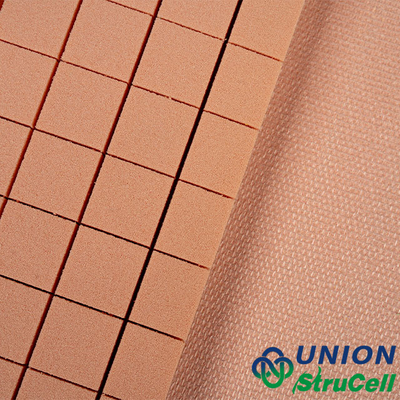
Product photograph: StruCell P100 structural PVC foam core. The pictured surface configuration is illustrative; confirm grade, dimensions and finish for the selected manufacturing process.
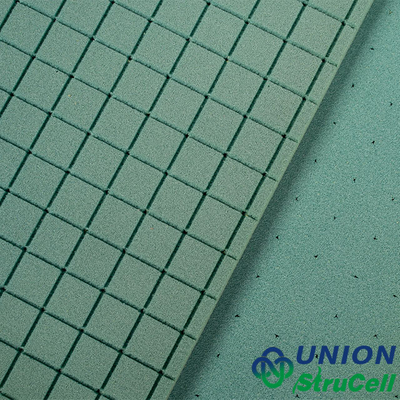
Product photograph: StruCell P130 structural PVC foam core. The pictured surface configuration is illustrative; confirm grade, dimensions and finish for the selected manufacturing process.
The most common mistake is selecting a core on material cost alone, without considering water resistance, consistency and processability. This can lead to a cheaper core that costs more overall once processing and warranty are accounted for.
Another mistake is ignoring water absorption for marine or outdoor applications. A core that absorbs water will gain weight and lose strength over time, undermining the structure.
A third mistake is failing to match the core to the processing method. Not every core survives autoclave or high-temperature processing, so the core must be rated for your specific process.
Choosing the right core is easier with a knowledgeable supplier. A good core foam manufacturer will help you weigh water resistance, stiffness, cost and sustainability, and will recommend the right material for your application.
A supplier that offers PVC foam, PET foam and other cores can give you an objective recommendation, rather than pushing a single material. This is valuable when the choice is genuinely close.
ISO 845:2006 defines measurement of apparent overall density and apparent core density for cellular plastics and rubbers. A grade designation is therefore not a substitute for a stated density measurement.
ASTM C273/C273M addresses shear properties of sandwich core materials. Compare results using the stated specimen, preparation and test conditions rather than inferring shear performance from density alone.
The three material families should be compared using the requirements of the finished structure. A particular grade may offer useful weight, processing or moisture characteristics, but no family automatically wins a category. Use documented data and representative trials to decide which construction meets the project’s requirements.
The right choice depends on your application, your processing method and your sustainability goals. By weighing these factors carefully — and by working with a knowledgeable supplier — you can select the core that delivers the best overall value.
For most marine and structural applications, a closed-cell fire-retardant PVC foam or a standard grade remains the proven, reliable choice.
Whatever core you choose, quality assurance is essential. A reputable core supplier controls density, cell structure and thickness to tight tolerances, and operates under ISO 9001 quality management processes to ensure consistency batch after batch.
Look for a supplier that provides complete datasheets, traceable batch records and application engineering support. This documentation is the foundation of a repeatable production process and a defensible quality position.
The table below lists the key standards and quality signals to look for when sourcing a core material.
| Quality signal | What it means |
|---|---|
| ISO 9001 | Quality management system; scope and validity need verification |
| Full datasheet | Documented density, strength and water absorption for the grade |
| Batch traceability | Ability to trace each batch back to its production record |
| Application support | Technical guidance throughout design and production |
Density is the common thread that runs through any core comparison, because it is the primary driver of both strength and weight. A fair comparison must compare cores at similar density, otherwise you are comparing apples to oranges.
Balsa's low density and high stiffness make it hard to beat on stiffness-to-weight, while PVC and PET foams trade some stiffness for consistency and water resistance. Understanding this trade-off is essential to an informed decision.
In practice, most designers specify a target density range first, then compare the materials available within that range on the other properties that matter for the application.
The three cores process differently, which affects both cost and quality. PVC and PET foams machine cleanly and thermoform well, and they are compatible with wet lay-up, vacuum bagging and infusion processes.
Balsa is typically supplied as end-grain blocks or sheets, and it requires more careful handling because of its natural variability and moisture sensitivity. It is often used in flat panels and simple geometries.
For complex curved parts, a thermoformable foam such as PVC is usually the better choice, because it can be shaped over a mould without the gaps and variability that can occur with wood cores.
Fire performance is a growing consideration in transportation and construction. Standard PVC foam is combustible, but fire-retardant grades are available that meet flammability standards, making them suitable for fire-sensitive applications.
PET foam also offers fire-retardant options, and balsa, being wood, is inherently combustible unless treated. For applications with fire-safety requirements, specify a fire-retardant grade and confirm the exact standard your project must meet.
For demanding fire-performance requirements, a fire-retardant PVC foam is often the most practical choice, combining fire resistance with the water resistance and mechanical performance that structural applications need.
A boatbuilder should compare qualified candidates against hull and deck requirements, including load cases, sealed details and moisture exposure. The selected core is a project-specific decision. Do not assume that all marine builders select the same chemistry or that a material choice alone prevents moisture-related damage.
A transport-panel programme with recovery goals should examine documented recycled content and an actual end-of-life pathway for the whole laminate. PET may be a candidate, but its use does not by itself prove recyclability. Compare structural performance and manufacturing evidence alongside environmental claims.
A builder of ultra-lightweight, cost-sensitive interior panels, where moisture is not a concern, might choose balsa for its exceptional stiffness-to-weight ratio and low cost.
These examples illustrate that there is no single "best" core — only the best core for each specific set of requirements.
A good core supplier is a partner in the decision, not just a vendor. They can provide comparative datasheets, samples and application guidance, and they can help you model the cost and performance trade-offs between materials.
Suppliers that offer multiple core materials are especially valuable, because they can give an objective comparison rather than steering you toward a single product.
Ultimately, the best way to decide is to test candidate cores in your own process, on your own parts, and to let the results — rather than the datasheet alone — guide the final choice.
Cost comparisons often focus on the purchase price of the core, but the real cost is the cost over the life of the structure. A core that absorbs water, or that varies in properties, can add cost through rework, repairs and reduced service life.
PVC foam, for example, may cost more than balsa up front, but its low water absorption and consistency can save money over the life of a marine structure by avoiding weight gain, strength loss and the repairs that follow a wet core.
PET foam's recyclability can also carry financial value, particularly for brands that market sustainability or that face end-of-life disposal costs. These lifecycle factors should be part of any thorough cost comparison.
A core material is only as good as the consistency of its supply. A material whose density or properties vary from batch to batch will produce variable parts, even if the design is sound.
This is one of the strongest arguments for PVC and PET foams over balsa, because they are produced under tight control and deliver uniform properties batch after batch. Balsa, as a natural product, inherently varies.
For high-volume or safety-critical production, choose a supplier that can demonstrate consistency with traceable batch records, and that can sustain that consistency over the long term.
The core choice influences the laminate design in subtle but important ways. A stiffer core allows thinner face sheets for the same panel stiffness, while a softer core requires thicker faces. A core with lower water absorption allows a lighter skin because less allowance is needed for moisture weight gain.
The core also affects the bond line. PVC and PET foams bond well with standard adhesives and resins, while balsa requires careful surface preparation and sealing to prevent moisture ingress.
These design implications mean the core should be chosen early in the design process, not as an afterthought, so that the face sheets, bond line and processing method can all be optimised together.
If sustainability is a priority, look for environmental certifications and recycled-content claims from your core supplier. PET foam suppliers often provide recycled-content options and can document the recyclability of the material.
PVC foam suppliers may offer lighter grades that reduce material use, and the durability of PVC foam contributes to sustainability by extending service life. Balsa is a renewable resource, and some suppliers provide certification of sustainable forestry.
Ask your supplier for the specific environmental documentation relevant to your market, and verify claims rather than relying on general marketing statements.
Summarise the candidates using actual grade data, comparable conditions and installed mass. Moisture resistance, stiffness and cost are not fixed rankings between material families. Record uncertainties explicitly so that missing temperature or fatigue data cannot be mistaken for a favourable result.
There is no universal best core. The right choice depends on your specific priorities: water resistance, mechanical performance, cost, consistency, temperature resistance or sustainability.
By understanding these trade-offs and testing candidates in your own process, you can select the core that delivers the best value for your application, and build structures that perform reliably over the long term.
The use of lightweight cores in structures is not new. Balsa has been used in lightweight construction for nearly a century, and it was one of the earliest core materials in composite sandwich panels, prized for its low density and high stiffness.
The introduction of synthetic foam cores — first PVC, later PET — was a major step forward, because it addressed the two biggest limitations of balsa: water absorption and natural variability. Foam cores brought consistency and water resistance to composite construction.
Modern foam and wood-core portfolios provide many grade and processing options. Better selection comes from current specifications and tested constructions, not from assuming every newer material is potentially recoverable where a suitable finished-part route exists. Review the exact product data and the intended waste route before making environmental claims.
The choice between foam and wood cores often comes down to water and consistency. Wood cores, led by balsa, offer outstanding stiffness-to-weight and low cost, but they absorb water and vary naturally.
Foam cores, whether PVC or PET, offer far lower water absorption and much better batch-to-batch consistency. These advantages are worth the higher material cost in most marine, wind and high-performance applications.
For applications where moisture is controlled and cost is paramount, balsa remains an excellent choice. For anything exposed to water or requiring repeatable production, foam is the safer bet.
When comparing cores, the datasheet is your primary source of truth, and reading it correctly is essential. Focus on the properties that matter for your application: density, compressive strength, shear strength, and water absorption.
Matched density can be a useful screening comparison, but equivalent functional performance is the more important design comparison. Different candidates may require different thicknesses or faces to meet the same deflection and strength limits. Keep test methods, directions and conditioning consistent, then compare the complete qualified panel rather than density alone.
Pay particular attention to water absorption for marine and outdoor applications, and to temperature resistance if your process involves elevated-temperature curing. When in doubt, ask the supplier for the full test report.
Some programmes source PVC foam from one supplier and PET foam or balsa from another, which is workable but adds coordination overhead. A supplier that offers multiple core materials can simplify this by providing a coordinated set of cores with consistent documentation.
A single-source approach also makes it much easier to maintain consistency across a product line, because the same quality standards and documentation apply to every core you buy.
Whether you use one supplier or several, the key is to verify consistency and documentation, and to test the cores in your own process before committing to production volumes.
Repeated-load performance should be evaluated using the relevant grade and construction under a defined fatigue programme. The knowledge base does not establish market dominance or a universal fatigue ranking between core families. Retained stiffness, damage and failure mode matter alongside the number of cycles.
PET foam also offers good fatigue performance, though it is generally considered slightly below PVC foam for the most demanding cyclic-loading applications. Balsa, despite its high static stiffness, can be more prone to localised failure under fatigue in wet conditions.
For long-term performance, water resistance and fatigue resistance go hand in hand, because a core that absorbs water loses both strength and fatigue life. This is another reason PVC foam is favoured for wet, dynamically loaded structures.
Weight is often the whole point of using a sandwich core, and the core choice directly determines how much weight you can save. Balsa offers the most stiffness for the least weight, which makes it attractive for weight-critical applications.
Calculate installed mass for the actual construction, including skins, adhesive, resin uptake, joints and local reinforcement. There is no universal small weight penalty for one family relative to another. Candidate panels must meet the same functional requirement before weight comparisons become meaningful.
In practice, the core is only part of the overall weight equation. The face sheets, the resin content and the design margins all contribute, and a consistent, predictable core allows tighter design margins, which can offset a slightly higher core weight.
To bring everything together, here is a practical checklist you can use when selecting a core material. Working through these points systematically will help you arrive at a defensible choice.
First, define the loads. Determine the compressive and shear strength your core must provide, and the weight you can accept. This sets the density range for your shortlist.
Second, define the environment. If the structure will be exposed to water or humidity, prioritise low water absorption, which points strongly toward closed-cell PVC foam.
Third, define your process. Confirm that each candidate core is rated for your cure temperature and pressure, and that it is compatible with your lamination method.
Fourth, define your cost and sustainability goals. Balance material cost, lifecycle cost and any recyclability or renewable-content requirements against your priorities.
Finally, test the shortlist in your own process and confirm availability and consistency from your supplier before committing. A little testing up front prevents costly surprises later.
The choice between PVC foam, PET foam and balsa is fundamentally a decision about trade-offs, and the best choice is the one that most closely matches your specific structural, environmental, cost and sustainability priorities. There is no single correct answer that fits every application or every manufacturer.
PVC, PET and balsa remain candidate families rather than preset answers for marine, recycling or low-cost applications. Request exact-grade data and process evidence, then test the shortlisted constructions. The result should identify which candidate meets this project’s requirements, with the limitations and acceptance criteria recorded.
Whatever you choose, verify the datasheet, test in your own process and work with a supplier that provides consistent material and solid documentation. These fundamentals — more than any single material property — are what lead to a reliable, long-lasting composite structure.
View documented StruCell P45 grade information as an additional material reference; this is not an automatic application recommendation.
List the exact grade, density range, thickness and surface configuration before entering strength values. For each property, add the test method, direction, conditioning and whether the number is typical or minimum. StruCell P100 is documented at 100 kg/m³, with compressive strength 2.0 MPa and shear strength 1.44 MPa. These values are a product-data reference, not proof that every PVC grade exceeds every PET or balsa grade.
Produce representative candidate panels using the intended resin, reinforcement and cure process. Record resin uptake, flow behaviour, machining quality and bond observations. Keep the finished thickness and acceptance plan consistent with the engineering requirement. If a different surface pattern is required for a candidate, include its resin and labour consequences rather than comparing only unprocessed sheet prices.
Evaluate inserts, penetrations, edge close-outs and transitions between materials. A flat coupon can miss the detail that governs the actual structure. Document joint preparation and load transfer across a mixed-core region, including local thickness changes and resin pockets. A hybrid layout can be useful, but it requires an engineered transition rather than an informal substitution of one material for another.
Separate verified results from assumptions and requests awaiting supplier confirmation. Compare total installed cost, inspection requirements and an appropriate maintenance plan as well as initial core cost. State why the selected construction meets this project’s targets. Do not turn a project-specific outcome into a universal marketing claim that one core family is always the safest, cheapest, stiffest or most sustainable option.
Closed-cell foam — A foam whose cells are sealed, giving low water absorption and consistent properties.
Thermoplastic foam — A foam made from a polymer that can be re-melted, such as PET, enabling recyclability.
Balsa — A lightweight natural wood used as a composite core, valued for its high stiffness-to-weight ratio.
Shear strength — The ability of a core to resist sliding forces, which is the primary load in a sandwich panel.
Water absorption — The amount of water a material takes up, expressed as a percentage; lower is better for marine cores.
Stiffness-to-weight ratio — A measure of how much stiffness a material provides for a given weight.
Sandwich panel — A structure of two face sheets bonded to a lightweight core, combining stiffness with low weight.
Recyclability — The ability of a material to be recovered and reused at the end of its life.
Fatigue resistance — The ability of a material to withstand repeated loading without progressive damage.
Autoclave — A pressurised, heated vessel used to cure composite parts at elevated temperature and pressure.
Neither is universally better. Compare the exact grades under matched test and processing conditions. Include finished-panel mass and the actual environmental evidence relevant to your project.
Strength depends on direction, density, grade and test method. End-grain balsa and foam data cannot be ranked without those details. Compare constructions meeting the same load case.
PET can be evaluated for a marine construction when its grade and laminate meet the requirements. Check moisture exposure, bond durability and sealed details. Do not select a marine core solely from its chemistry.
Prices depend on grade, configuration, quantity and supply conditions. Compare installed cost including resin, labour and inspection. A cheaper sheet is not necessarily a cheaper qualified panel.
Closed-cell PVC is a useful marine candidate, but this article does not establish market share or universal superiority. Selection needs grade data and a qualified laminate. Maintain sealed edges and penetrations regardless of core choice.
Some PET products have documented recycled content or potential recovery routes. A finished bonded sandwich is not automatically ready for recovery. Verify actual local recovery and distinguish it from recycled feedstock.
Wet wood can be vulnerable to biological degradation under suitable conditions. Protection and inspection therefore matter. Moisture behaviour and service life must be assessed for the finished construction.
Mixed-core layouts can be engineered for specific load regions. Validate transitions, adhesive details and local geometry. Do not treat a material substitution as equivalent without review.
Choose a grade from structural, processing and exposure requirements. P100 data include 100 kg/m³ density and 1.44 MPa shear strength, but they are not design allowables. Test the intended construction.
Compare exact-grade evidence, representative panels and complete installed cost. Include moisture, directionality, details and end-of-life requirements. Document why the selected construction meets the project targets.


