

Author: Site Editor Publish Time: 2026-10-23 Origin: Site


USA Pickleball provides an equipment submission process and an approved paddle list. Approval applies to the finished model, not merely its foam chemistry or supplier certificate. Before making tournament claims, check the current requirements and listing for the exact product. Material changes should be reviewed within the manufacturer’s approval obligations rather than assumed to preserve an existing status.
Core mass equals density multiplied by volume. For an illustrative untrimmed blank measuring 0.20 m by 0.25 m by 0.014 m, volume is 0.0007 m³. At 80 kg/m³ the blank core mass is 56 g; at 48 kg/m³ it is 33.6 g. These are calculated examples, not paddle specifications, and exclude skins, adhesive, shaping waste, handle and edge protection.
A single centre impact does not describe the whole striking face. Test several locations using a controlled setup and record rebound response, vibration and damage observations. Keep ball condition and measurement procedure consistent. Combine objective measurements with clearly labelled player feedback, and avoid turning an anecdotal preference into a universal claim about control, power or the size of a sweet spot.
A change in response can arise from core crushing, interface separation or face-sheet damage. These are different failure modes and require different corrective actions. Retain baseline measurements and inspect conditioned prototypes rather than diagnosing from sound alone. A successful foam compression test is useful material information but cannot replace repeated-impact evaluation of an assembled paddle.
Pickleball paddle development involves choices about mass, feel, durability and manufacturing consistency. This guide focuses on evaluating structural PVC foam as one candidate core. It does not assert market leadership, establish a universal player preference or substitute for finished-model equipment testing.
At the centre of this innovation is the paddle core. The core determines much of a paddle's weight, feel, power and durability, which is why the choice of core material has become one of the most important and most closely guarded decisions in competitive paddle design and manufacturing.
The core is one important part of a paddle, alongside the face construction, geometry, adhesive, edge detail and weight distribution. PVC structural foam can be evaluated as a candidate, but the current knowledge base does not prove that it dominates pickleball manufacture or improves every player’s experience. Finished-paddle trials are essential.
A modern pickleball paddle is a sandwich structure, much like a high-performance composite panel in aerospace or marine. It consists of a rigid face sheet on each side — typically carbon fibre or fibreglass — bonded to a lightweight polymer core, with a protective edge guard running around the perimeter.
The face sheets carry the bending loads and provide the striking surface, while the core holds the faces apart and transfers the impact forces between them. This sandwich construction is what gives the paddle its stiffness and its characteristic feel.
Because the core occupies most of the paddle's volume, its density, thickness and internal cell structure have a profound effect on the paddle's overall weight, balance, power, control and long-term durability. A well-chosen core is the foundation of a genuinely good paddle.
The core does more than fill space — it actively shapes how the paddle plays. A lighter core makes the paddle easier to swing and reduces fatigue, while a denser core adds power and a firmer feel.
The core also controls the size and consistency of the sweet spot. A core with uniform density and cell structure responds predictably across the face, so the ball behaves the same whether it strikes the centre or slightly off-centre, giving players the confidence to swing freely without worrying about unexpected dead spots.
Finally, the core influences vibration and sound. A well-chosen foam core damps unwanted vibration, producing a cleaner feel and a more pleasant, quieter sound — qualities that matter both to players and to communities concerned about paddle noise near courts and residential areas.
Foam density and thickness determine part of the core mass, while the face sheets and bonding system determine much of the completed stiffness. Closed-cell morphology alone does not prove a uniform rebound map. Compare measured paddle response at multiple impact locations before making claims about manoeuvrability, consistency or sweet spot.
CNC machining can prepare controlled profiles and thicknesses, but the actual tolerance must be agreed and measured. Tooling, fixturing and foam condition influence the result. Specify an inspection plan for thickness and flatness instead of assuming a generic machining capability guarantees identical finished paddles.
Bond durability depends on the core surface, adhesive formulation, cure, face sheet and impact history. A structural foam photograph or datasheet is not evidence of thousands of successful paddle impacts. Establish a repeated-impact and bond inspection programme for the proposed finished construction before making durability claims.
When specifying a paddle core, three key specifications matter most of all: density, thickness and internal cell structure. Density controls weight and power, thickness controls the sweet spot and feel, and cell structure controls overall consistency and long-term durability.
Treat thickness as an experimental design variable rather than a fixed recipe for control or power. Maintain the same face sheets and edge construction when comparing thickness variants, and record mass and balance. This helps isolate core effects instead of attributing all differences between commercially distinct paddles to thickness alone.
A thickness change alters geometry and mass, but its effect on playing response depends on the entire construction. The table below identifies what to measure rather than prescribing universal thickness-to-feel rankings. Validate off-centre response, rebound and player feedback using consistent trial conditions.
| Design variable | What changes | What to verify |
|---|---|---|
| Core thickness | Geometry, core volume and face separation | Mass, stiffness and mapped paddle response |
| Core density | Core mass and grade properties | Impact damage, bond behaviour and balance |
| Face and edge construction | Complete paddle load path | Finished-model performance and approval |
PVC foam, honeycomb and other polymer constructions should be compared as complete paddle designs. Material labels do not establish a universal order of weight, consistency or durability. Record the actual candidate specifications and test comparable prototypes using the same face sheets, geometry and acceptance criteria.
| Core option | Specify before comparing | Evidence needed |
|---|---|---|
| PVC foam | Exact grade, density, thickness and surface | Finished prototype measurements |
| Honeycomb | Material, cell geometry, wall and thickness | Same finished-paddle test programme |
| Other polymer construction | Material architecture and dimensions | Comparable mass, durability and response tests |
The density of the core sets the paddle's weight and power, while the cell structure sets its consistency. A fine, uniform cell structure produces a predictable response and a clean feel, while a coarse or inconsistent structure can cause dead spots.
Density options support controlled prototype comparisons, but ageing response must be tested. Closed-cell structure can limit one moisture pathway; it does not prevent bond degradation, damage or every change in feel. Store and condition prototypes consistently so that differences are traceable to the design variables.
PVC foam is produced by expanding a PVC-based compound into a rigid, closed-cell sheet. The sheet is then cut to size and machined to the exact thickness and profile required for the paddle core.
Controlled foam sheets can support repeatable machining when batch properties and dimensional acceptance are verified. This is a manufacturing advantage to evaluate, not evidence of market leadership. Inspect both the cut core and the assembled paddle, because the bond line and face sheets can introduce additional variation.
Core flatness and thickness deserve inspection before bonding. CNC equipment is one way to make profiles, but it does not establish superiority over every alternative material. Define the datum, measurement locations and allowable variation, then confirm them on production samples rather than relying on an equipment description.
The foam can also be cut to the final paddle profile, including the rounded corners and the cut-out areas, reducing downstream assembly work. This precision contributes directly to the consistent feel that players value.
The bond between the core and the face sheets is critical to paddle durability. PVC foam bonds well with the structural adhesives used in paddle manufacturing, producing a strong, durable bond line.
Follow a qualified preparation procedure for the actual foam and adhesive. Cut cells and machining features can affect local resin uptake, so a closed-cell designation does not ensure a uniform bond line. Check adhesive coverage and cure on trial coupons before using the procedure for paddle prototypes.
Repeated impacts can cause local crushing, interface damage or face-sheet changes. Structural PVC foam is not guaranteed to rebound without permanent deformation. Evaluate prototype paddles with a defined impact programme, inspect for damage and compare their response before and after conditioning.
Durability claims need finished-product evidence, including repeated impact, edge damage and bond inspection. The current StruCell product data do not establish a tournament service life or prove that competing cores degrade sooner. Keep performance statements limited to the tested construction and conditions.
The way a paddle feels and sounds is heavily influenced by the core. PVC foam damps vibration, producing a cleaner feel on impact and reducing the harsh buzz that some stiffer cores transmit to the hand.
Sound depends on face stiffness, geometry, impact conditions and the entire assembled paddle. Do not label a PVC core as quiet or acoustically approved without relevant finished-paddle testing. Where facilities or governing bodies impose requirements, use their current evaluation process rather than extrapolating from foam morphology.
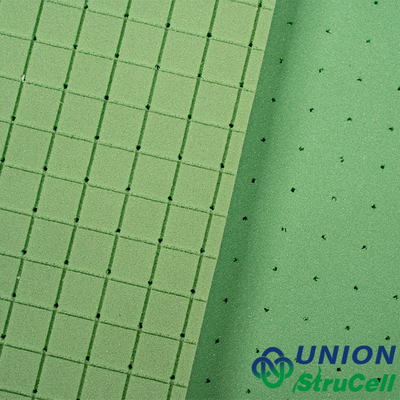
Product photograph: StruCell P80 structural PVC foam core. The pictured surface configuration is illustrative; confirm grade, dimensions and finish for the selected manufacturing process.
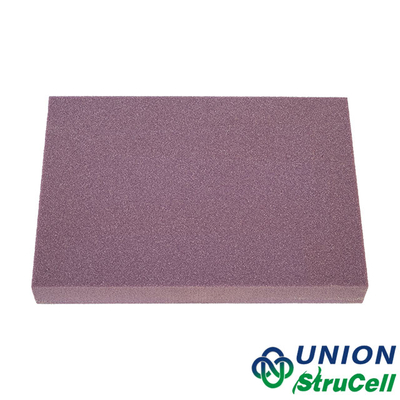
Product photograph: StruCell P45 structural PVC foam core. The pictured surface configuration is illustrative; confirm grade, dimensions and finish for the selected manufacturing process.
One of the strengths of PVC foam is its customisability. Density, thickness and cell structure can all be tuned, and cores can be supplied pre-cut to the final paddle dimensions, simplifying assembly.
Prototype variants can explore different densities and thicknesses, but power-oriented and control-oriented labels require measured paddle response. Keep face sheets, adhesive and dimensions consistent where possible. Record the trade-offs rather than assuming denser foam automatically creates more power or softer foam automatically creates more control.
Consistency is everything in paddle manufacturing, because players notice even small variations between paddles. PVC foam is produced under tight control, with uniform density and cell structure from sheet to sheet and batch to batch.
A quality-focused foam supplier, operating under ISO 9001 processes, provides the traceability and documentation that paddle brands need to deliver a consistent product at scale.
The same qualities that make PVC foam an excellent pickleball core also make it suitable for other paddle and racket sports, as well as surfboards, paddleboards and other lightweight composite equipment.
Wherever a light, durable and consistent core is needed, closed-cell PVC foam is a proven choice, which is why it has become a staple material across the broader sports and leisure industry.
The cost of a PVC foam core is driven mainly by density and precision. Higher-density cores cost more because they contain more material, and tighter tolerances add machining cost.
However, the total cost of the paddle also depends on assembly and scrap, and a consistent, easy-to-machine core reduces both. This makes PVC foam cost-effective when the whole manufacturing process is considered.
The most common mistake is choosing a core density without considering the full paddle design, leading to a paddle that is too heavy or too soft. The core must be matched to the face sheets and the target feel.
Ignoring tolerance control makes prototype comparisons less useful. Agree measurable thickness, flatness and profile limits with the supplier, then inspect the delivered cores and completed paddles. A dimensional promise without an acceptance method is not adequate evidence of manufacturing consistency.
Finally, some manufacturers overlook the bond between the core and the face sheets, which is where many durability failures begin. Proper surface preparation and a compatible adhesive are just as important as the core material.
USA Pickleball provides a submission process for testing and approval of equipment. A supplier’s foam data do not constitute approval of a finished paddle; manufacturers need the relevant model-specific evidence.
ISO 845:2006 defines measurement of apparent overall density and apparent core density for cellular plastics and rubbers. A grade designation is therefore not a substitute for a stated density measurement.
PVC foam can be considered during paddle development where machinability and documented structural properties are useful. It is not presented here as the leading or universally superior pickleball core. The value of the material must be demonstrated in the finished design through performance, durability and approval testing.
For manufacturers, it offers the precision and consistency needed for high-volume production, and for players, it delivers the predictable, high-performance feel they expect from a modern paddle.
Whether you are developing a new paddle or refining an existing line, understanding the role of the core — and why PVC foam is the material of choice — is the foundation for a better product.
Early pickleball paddles were simple wooden boards, durable but heavy and unforgiving. As the sport grew, manufacturers began to adopt the composite sandwich construction long used in aerospace and marine, and the modern paddle was born.
The introduction of polymer cores was a turning point. Replacing solid wood with a lightweight foam core made paddles dramatically lighter and more comfortable, while the addition of composite face sheets improved power and control.
Today, paddle design is a highly specialised field, with core material, face material, thickness and balance all tuned to deliver a specific playing feel. PVC foam has emerged as one of the most important materials in this evolution.
Core mass contributes to paddle weight and balance, but face sheets, adhesive, handle and edge protection also matter. Do not assume a denser core produces more powerful groundstrokes. Compare the mass distribution and response of assembled prototypes under controlled conditions.
Balance describes where the weight sits in the paddle. A head-light paddle feels fast in the hand, while a head-heavy paddle delivers more plow-through on the ball. The core's density and distribution are key levers in tuning balance.
Because players have strong individual preferences, manufacturers often offer the same paddle shape in multiple weight classes, using different core densities to shift the weight and balance point.
The face sheets and the core are a system, not independent parts. The face sheets provide stiffness and a hard striking surface, while the core provides thickness, damping and the energy return that gives the paddle its feel.
Face-sheet stiffness and core behaviour interact with geometry and bonding. Their effects on feel and rebound must be measured in the finished design. No universal pairing rule establishes crispness, control or a springy response for every combination.
The bond between them is just as important. A strong, uniform bond line ensures the face and core act as one structure, which is essential for durability and for the consistent feel that players notice on every shot.
Pickleball paddles are subject to performance and durability testing to ensure they meet the standards of the sport's governing bodies. Weight, size, surface roughness and deflection are among the properties that are tested.
The core plays a central role in these tests, because it affects deflection, energy return and durability. A consistent, high-quality core helps a paddle pass these tests reliably, batch after batch.
Material characterisation helps engineers plan development, but it does not guarantee faster approval or reduce every test risk. Approval concerns the submitted finished paddle. Check the governing body’s current submission requirements and approved list, and avoid describing a core material itself as tournament certified.
Sustainability is becoming an important consideration in paddle manufacturing. PVC foam contributes to sustainability in part through its durability — a longer-lasting paddle means fewer paddles need to be produced and discarded.
The foam is also easy to machine with minimal waste, and offcuts can be minimised through efficient nesting of the paddle profile in the foam sheet. This reduces material waste in production.
At end of life, PVC foam should be handled according to local waste regulations. For brands prioritising recyclability, PET foam offers an alternative core material, though PVC foam remains a candidate to evaluate for its water resistance and mechanical performance.
Choosing the right foam supplier is as important as choosing the right foam. A good supplier provides consistent material, tight tolerances and reliable documentation, all of which are essential for high-volume paddle production.
Look for a supplier that can machine cores to your exact specifications, offers the density range you need, and supports you with technical guidance throughout product development. A core foam manufacturer with ISO 9001 processes is a strong signal of quality.
A supplier that can also supply the foam in sheet form gives you the flexibility to prototype quickly and to scale to production when the design is finalised.
Prototyping is where paddle designs are refined, and PVC foam makes the process fast and cost-effective. Because the foam machines easily and is available in a wide density range, designers can quickly produce multiple core variants to test different feels.
A typical prototyping cycle starts with a sheet of PVC foam, which is machined to the core profile and thickness, then bonded to the face sheets and tested. If the feel is not right, the density or thickness is changed and the cycle repeats.
This rapid iteration is one of the reasons PVC foam is so popular with paddle brands. It shortens development time and lets designers explore a wide design space before committing to production tooling.
Paddle feel is the subjective experience of how a paddle responds on impact, but it has objective roots in the core material. The core's density, cell structure and thickness all translate directly into the force, sound and vibration the player feels.
A core that is too soft feels mushy and under-powered, while a core that is too dense feels harsh and transmits too much vibration. The ideal core sits between these extremes, returning energy cleanly while damping unwanted vibration.
Because PVC foam offers fine control over density and cell structure, it gives designers a precise tool for tuning feel. This is why so many premium paddles are built around a PVC foam core.
The classic tension in paddle design is power versus control, and the core is where this balance is struck. A denser core stores and returns more energy, favouring power, while a softer, thicker core absorbs more energy, favouring control and touch.
Player preferences should be gathered through clearly described prototype trials. Density and thickness cannot independently assign a design to power or control categories. Keep subjective feedback separate from objective mass, response and durability results.
By offering a range of densities, PVC foam lets manufacturers produce a family of paddles — power-oriented, control-oriented and balanced — from the same core material, simplifying their supply chain.
Paddles are used indoors and outdoors, often in humid conditions, so the core must resist moisture. Closed-cell PVC foam absorbs very little water, so the paddle's weight and feel remain stable over time, even with outdoor use.
Low uptake can be useful when evaluating moisture exposure, but a paddle’s ageing response also depends on its skins, adhesive and edge construction. Condition assembled prototypes and inspect them after exposure. Do not promise season-after-season consistency without a defined durability test and maintenance conditions.
For manufacturers, this durability means fewer warranty claims and a stronger reputation, which is a meaningful commercial advantage in a competitive market.
Different PVC grades have different documented material properties. Their effect on a paddle must be established using the intended faces, bonding and geometry. Higher density increases dry core mass for the same volume, but it does not automatically produce greater power.
The cell structure also matters. A fine, uniform cell structure gives a consistent feel and a clean appearance when the core is exposed at the edge, while a coarse structure can cause dead spots.
A specialist foam supplier can recommend the right grade for your target weight and feel, and can supply the same grade consistently over time, which is essential for a repeatable product. See our composite sandwich core material range for the available options.
Paddle core materials continue to evolve, driven by demand for lighter, more durable and quieter paddles. PVC foam remains at the centre of this evolution, thanks to its tunability and consistency.
Emerging developments include finer cell structures, multi-density cores that combine a soft centre with a firm edge, and even greater emphasis on acoustic control. These advances build on the strengths that PVC foam already offers.
For a paddle brand, partnering with a forward-looking foam supplier ensures access to the latest materials and the support to apply them, keeping your products at the front of the market.
Turning a sheet of PVC foam into a finished paddle core is a precise, multi-step process. It begins with the foam sheet, which is cut and machined to the exact thickness and profile required for the paddle.
The foam is typically machined on CNC equipment, which can hold tight tolerances and produce complex profiles, including the rounded corners and edge details of a modern paddle. This precision is essential for a consistent product.
After machining, the core is inspected for thickness, flatness and surface quality before it is bonded to the face sheets. Each step is controlled to ensure that every core matches the design specification.
The result is a ready-to-assemble core that arrives at the paddle assembly line flat, clean and dimensionally accurate, reducing downstream work and improving final product consistency.
The edge guard is the paddle's first line of defence, protecting the exposed edge of the core from impact and wear. A well-designed edge guard extends the paddle's life by preventing edge damage, which is one of the most common failure modes.
The core's edge must be clean and consistent for the edge guard to bond properly. PVC foam machines to a clean edge, which helps the guard sit flush and bond securely around the perimeter.
Together, the core and edge guard work as a system: the core provides the performance, and the guard protects it. Choosing a core that machines cleanly is an often-overlooked factor in edge-guard quality and durability.
Evaluating a paddle core supplier comes down to consistency, precision and support. The supplier must deliver foam of uniform density and cell structure, machined to tight tolerances, batch after batch.
Documentation and traceability matter too. A supplier operating under ISO 9001 processes, with full datasheets and batch records, gives you the confidence to build a repeatable product at scale.
For paddle development, prioritise dimensional, mechanical and finished-product approval evidence. A fire classification for a foam grade does not establish pickleball compliance and is not automatically relevant to paddle certification. Request additional certifications only where a specific market or contractual requirement calls for them.
Several misconceptions surround pickleball paddle cores, and clearing them up helps manufacturers and players make better decisions. The first is that a heavier core is always more powerful — in reality, the core density, thickness and face stiffness all interact, and a lighter core with a stiffer face can be just as powerful.
A second misconception is that a softer core always gives more control. While a soft core absorbs energy and can improve touch, too much softness produces a mushy feel and reduces power, so the ideal is a careful balance rather than an extreme.
A third misconception is that all foam cores are essentially the same. In fact, the density, cell structure and consistency of the foam vary significantly between suppliers, and these differences show up directly in the paddle's feel and durability.
Understanding these misconceptions helps both manufacturers and players evaluate paddles more effectively, and it reinforces why the choice of a quality core material, such as a well-specified closed-cell PVC foam, matters so much.
The applicable equipment requirements cover the finished paddle and may change. Check USA Pickleball’s current official requirements and submission process; do not infer a maximum weight or approval criterion from this general materials guide. A core choice does not by itself establish compliance.
The rules also govern surface roughness and the properties of the striking surface, which affects how the face and core interact. A core that is too lively, combined with a high-friction face, can produce a paddle that fails the governing body's tests.
For manufacturers, understanding the interplay between the rules and the core material is essential to designing paddles that are both compliant and competitive. A tunable material like PVC foam makes it easier to hit the target on weight, size and feel simultaneously.
In practice, most manufacturers settle on a core specification through a combination of rule compliance, player testing and production feasibility. Starting from a consistent, well-characterised PVC foam core removes one of the biggest variables from that process, letting the design team focus on tuning the paddle rather than fighting material inconsistency.
View documented StruCell P60 grade information as an additional material reference; this is not an automatic application recommendation.
Begin with one face-sheet construction, one approved bonding procedure and a defined outline. Change density or thickness one variable at a time where practical. Number every specimen and record foam batch, dimensions, adhesive mass and cure. This makes the results interpretable: a lighter prototype with different skins and a different edge guard cannot demonstrate the effect of density alone. Use the same assembly controls for subsequent production trials.
Record total mass and the balance location after the complete paddle has been assembled. Core calculations are useful for screening, but handle reinforcement, edge protection and adhesive can shift the final balance. Compare objective measurements before describing a prototype as easier to manoeuvre. If player testing is used, identify the test group and conditions so that subjective feedback is not confused with a material specification.
Define the impact locations, conditioning exposure and inspection intervals with the product engineer. Check response changes, visible edge damage and signs of separation. Do not create a service-life claim by converting an arbitrary number of laboratory impacts into years of play. Keep the claim attached to the tested construction and disclose the relevant test conditions in technical communications. Investigate unusual response changes before advancing the prototype.
Documented StruCell P80 density is 80 kg/m³, compressive strength 1.4 MPa and shear strength 1.15 MPa. These values help screen a candidate core but do not predict paddle rebound or compliance. Submit the finished model through the applicable approval process and check the current approved list before advertising eligibility. Neither a foam supplier’s quality-system certificate nor a general sports application statement substitutes for that evidence.
Core — The lightweight centre layer of a paddle or sandwich panel, bonded between two face sheets to provide stiffness at low weight.
Face sheet — The rigid outer layer of a paddle or sandwich panel, typically carbon fibre or fibreglass, that carries the bending loads.
Sweet spot — The area of the paddle face that delivers the most consistent, comfortable response; a larger core-dependent region improves forgiveness.
Density — The mass per unit volume of a material, expressed in kg/m³; higher density means more weight and stiffness.
Closed cell — A foam structure in which each cell is a sealed bubble, giving low water absorption and consistent mechanical properties.
Delamination — The separation of the face sheet from the core, usually caused by poor bonding or impact damage.
Tolerance — The allowable variation in a dimension; tight thickness tolerances are essential for a consistent paddle.
CNC machining — Computer-controlled cutting that produces precise, repeatable parts such as paddle cores.
Impact resistance — The ability of a material to withstand repeated impacts without denting or cracking.
Vibration damping — The reduction of unwanted vibration, which improves feel and sound in a paddle.
No material is universally best for every paddle design. Evaluate PVC foam alongside other candidates using matched prototypes. Confirm finished-model approval before making tournament claims.
Thickness should be chosen through prototype testing with the intended faces and edge detail. Thicker does not automatically mean more control or a larger sweet spot. Measure the complete paddle’s mass and response.
Durability depends on the finished construction and use conditions. Test repeated impact, edge damage and bond integrity. Foam datasheet values alone do not establish paddle service life.
Profiles and thicknesses can be discussed for a prototype programme. Confirm achievable dimensions, tolerances and the selected grade with UNION COMPOSITES. Custom geometry still needs finished-product validation.
Thickness changes core volume and the separation of the face sheets. Its effect on rebound and feel also depends on skins, adhesive and geometry. Compare controlled prototypes rather than relying on a universal thickness chart.
The core can influence vibration, but sound is a property of the complete paddle and test conditions. Measure assembled prototypes before making quiet-play claims. Check any applicable acoustic approval requirements separately.
Use a resin or adhesive procedure qualified for the foam and face materials. Confirm preparation, coverage and cure on trial coupons. Inspect the finished paddle’s interface after durability testing.
Compare actual density, thickness and geometry rather than material names. Calculated core mass is only part of total paddle mass. Adhesive, skins, handle and edge protection must also be included.
There is no universal service life established by the current foam data. Use a defined finished-product durability programme and appropriate inspection advice. Do not translate laboratory impacts directly into years of play.
Ask UNION COMPOSITES about documented StruCell grades and prototype machining requirements. Provide the target dimensions, face materials and test plan. The supplier discussion does not constitute paddle approval.


