

Author: Site Editor Publish Time: 2025-10-21 Origin: Site


Top search: "Is PVC thermosetting or thermoplastic?" At UNION COMPOSITES, we see engineers confused by conflicting answers. Here's the truth on three key questions:
1. Is PVC thermosetting or thermoplastic?
2. Is Linear PVC Foam thermosetting or thermoplastic?
3. Is Crosslinked PVC Foam thermosetting or thermoplastic?
The answer depends on structure—dive in for our DNV-GL certified analysis.
Is PVC thermosetting or thermoplastic? PVC is thermoplastic—remeltable chains.
Is Linear PVC Foam thermosetting or thermoplastic? Thermoplastic—heat-formable like PVC.
Is Crosslinked PVC Foam thermosetting or thermoplastic? Thermoset—no remelt, cross-linked.
Before we can talk about PVC, we need to understand the two major families of plastics. Think of it like the difference between butter and a baked cake.
A thermoplastic is a polymer that becomes soft and pliable when heated and solidifies when cooled. This process is completely reversible, meaning you can repeat it over and over without significantly degrading the material.
· The Analogy: Think of a stick of butter. You can melt it in a pan, and when it cools, it becomes solid again. You could melt and re-solidify that same butter multiple times.
· Molecular Structure: Thermoplastics consist of long polymer chains that are not chemically bonded to each other. Polymer chains are not permanently cross-linked. When heated, these chains can slide past one another, allowing the material to flow.
· Key Characteristics:
o Can be remelted and reshaped. Soften when heated and can be reshaped and reprocessed multiple times (within thermal stability limits).
o Generally recyclable. Typically weldable, recyclable by remelting or re-extrusion.
o Good impact resistance.
· Common Examples: Polyethylene (plastic bags), Polypropylene (containers), PET, PMMA, polycarbonate, and, as we'll see, PVC.
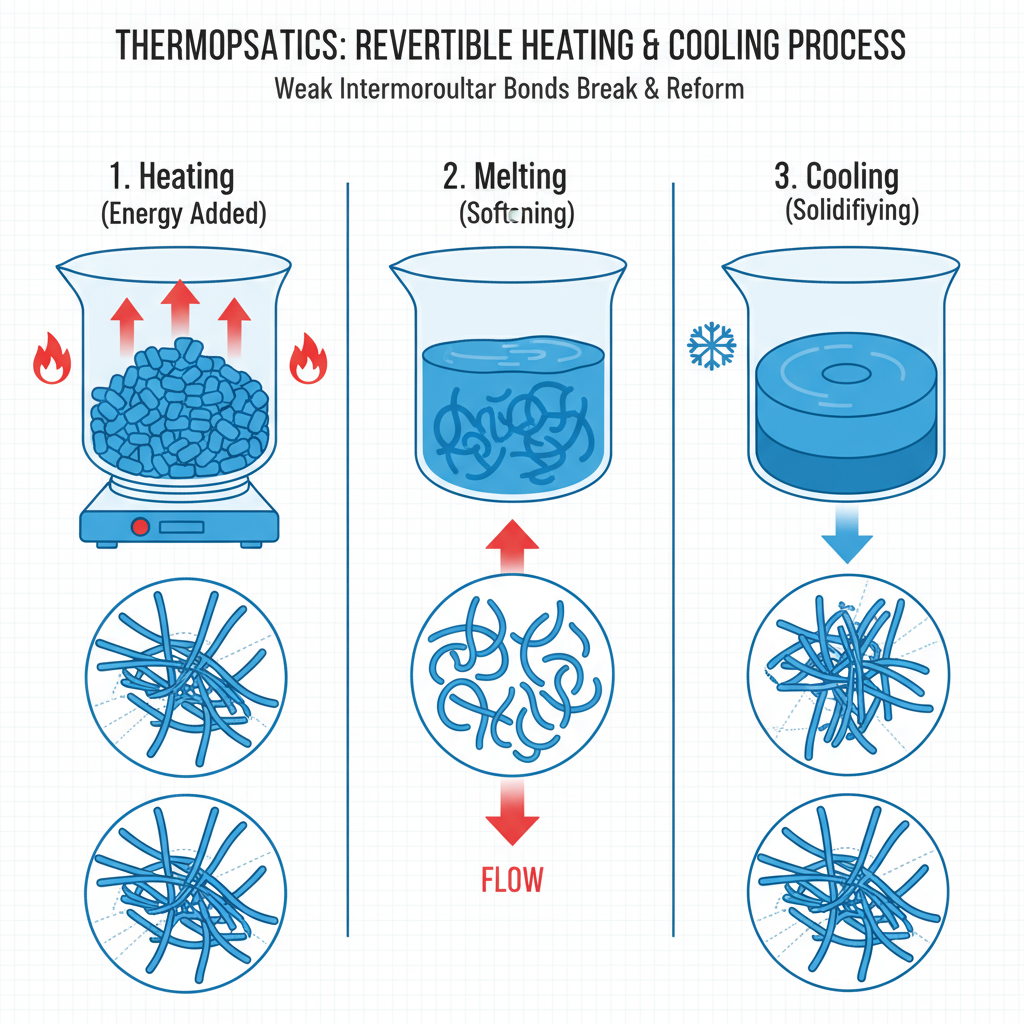
A thermoset, or thermosetting polymer, is a material that is permanently "set" once it's cured. The curing process involves a chemical reaction (often initiated by heat, a catalyst, or radiation) that creates strong, irreversible bonds between the polymer chains.
· The Analogy: Think of baking a cake. Once you mix the ingredients and bake them, you get a solid cake. You can't "un-bake" it or melt it back down into batter. If you apply too much heat, it will just burn.
· Molecular Structure: During curing, the polymer chains form a rigid, three-dimensional network through a process called cross-linking. These strong covalent bonds lock the chains in place permanently. Polymer chains become permanently cross-linked during curing (chemical reaction or irradiation).
· Key Characteristics:
o Cannot be remelted; instead, they char or degrade at high temperature. Not reprocessable by melting; typically machined, not welded.
o Excellent thermal and chemical resistance.
o High rigidity and dimensional stability.
· Common Examples: Epoxy resin, Bakelite, phenolic, melamine, cured polyurethane, and cross-linked PVC.

PVC, or polyvinyl chloride, is one of the most versatile plastics on the planet. First synthesized in the 19th century, it exploded in popularity during World War II as a rubber substitute. Today, it's everywhere—from plumbing pipes and vinyl flooring to medical tubing and credit cards. Manufacturers produce roughly 40 million tons of PVC annually, making it the third most common plastic after polyethylene and polypropylene.
At its heart, PVC is a synthetic polymer made from vinyl chloride monomers. It's produced through polymerization, where these building blocks link up into long chains. What makes PVC stand out is its adaptability: add plasticizers for flexibility (like in garden hoses), or keep it rigid for window frames. It's affordable, durable, and resistant to chemicals, which is why it's a go-to in construction and packaging.
PVC (polyvinyl chloride) is a vinyl polymer widely used in pipes, profiles, wire and cable, films, and foams. It can be:
· Rigid (uPVC) for pipes, window frames, boards.
· Flexible (plasticized PVC) for cables, flooring, and flexible sheets.
Key traits:
· Inherently flame-resistant due to chlorine content.
· Amorphous; softens above Tg (~80 °C) and is typically processed around 160–200 °C with stabilizers to prevent HCl release and degradation.
· CPVC means chlorinated PVC (still a thermoplastic); it is not the same as cross-linked PVC.
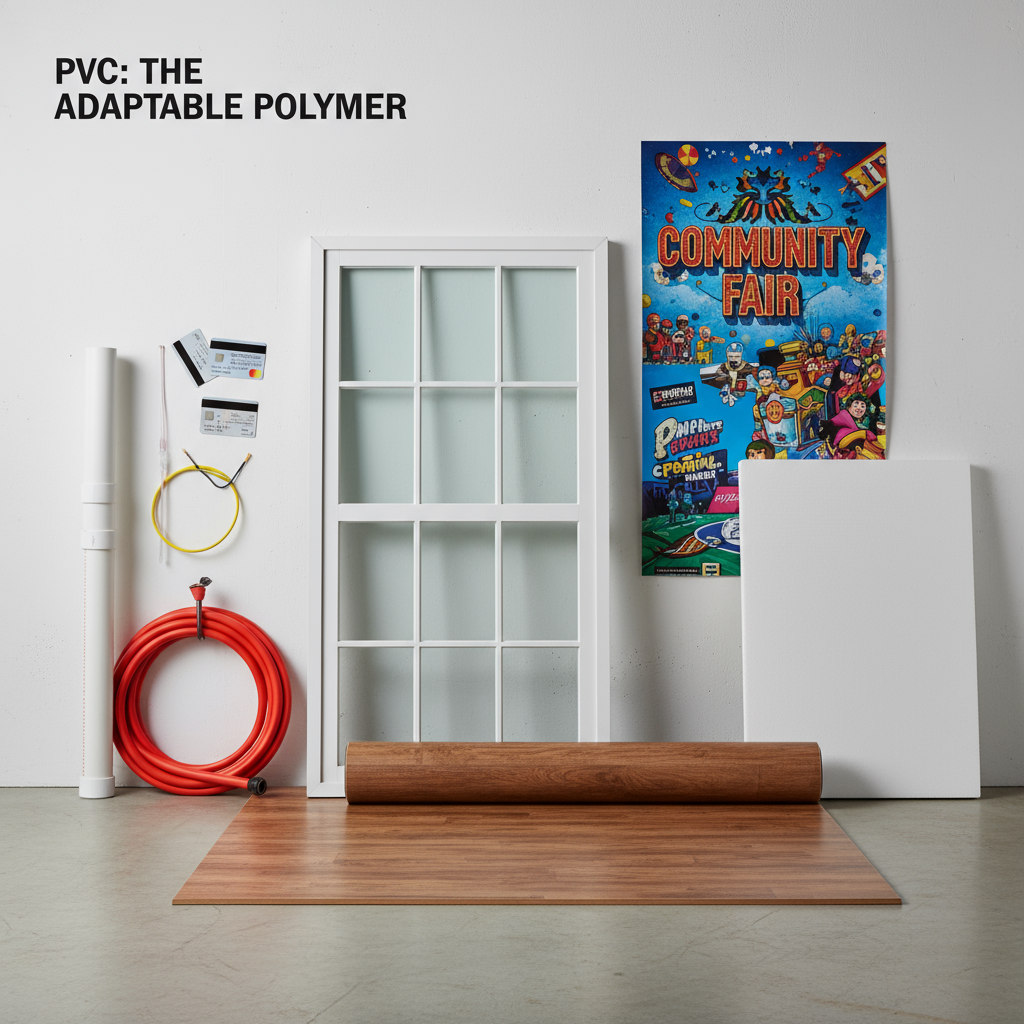
PVC is fundamentally a thermoplastic. Its polymer chains are held together by weak intermolecular forces that weaken with heat, allowing the material to flow. It softens when heated above its glass transition temperature (around 80-100°C, depending on the formulation) and can be reshaped multiple times. This makes it ideal for extrusion, injection molding, and even 3D printing in some forms.
The thermoplastic nature of PVC means that when you heat it, the molecular chains slide past each other, allowing the material to flow and take new shapes. Once cooled, these chains lock into position again. This process can be repeated many times, which is why PVC products can be recycled and reprocessed into new items. In my experience working with industrial clients, PVC's thermoplastic nature shines in recycling programs. Scrap PVC from old pipes can be melted down and reformed into new products, reducing waste. However, it's not invincible—prolonged exposure to high temperatures can cause degradation, releasing harmful gases like hydrogen chloride. That's why proper ventilation is key in processing.
If you're wondering about variations, some PVC compounds can mimic thermoset traits through additives, but pure PVC remains thermoplastic at its core.
PVC foam takes the base PVC polymer and amps it up with a foaming process, creating a lightweight, cellular structure. Imagine whipping air into batter to make a fluffy cake—that's similar to how PVC foam is made, using blowing agents to form gas bubbles during extrusion or molding.
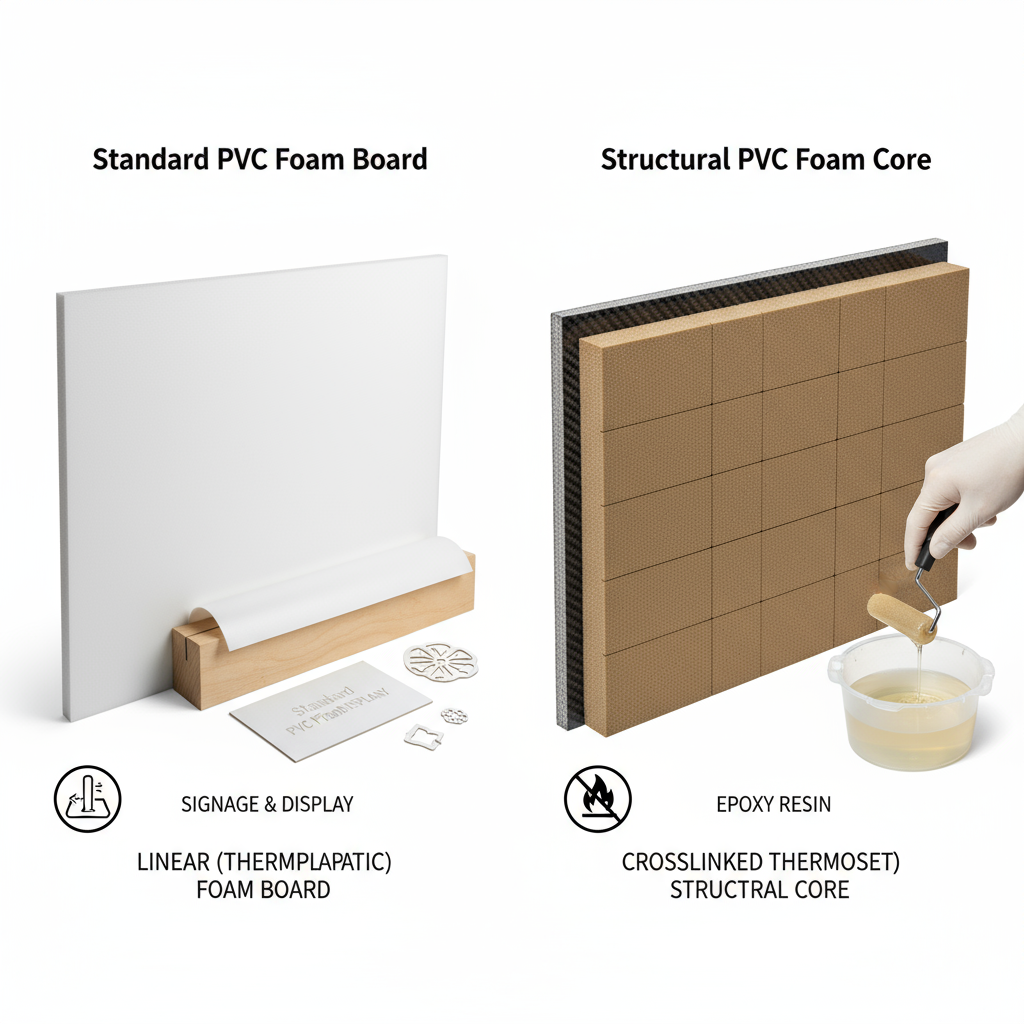
PVC foam, also known as expanded PVC or foamed PVC. Two broad families dominate:
· Foamed PVC sheet/board (often called expanded PVC, free-foam, or Celuka board)
o Typically rigid, lightweight sheets for signage, displays, shopfitting, thermoformed parts, and fabrication.
o Usually a linear (non-cross-linked) thermoplastic foam.
· Structural PVC foam core (closed-cell)
o Low to medium density cores used inside composite sandwich panels.
o Available as linear (non-cross-linked) or cross-linked grades; closed cells reduce water uptake.
For more details, please check <What is PVC FOAM?>
Like its parent material, standard PVC foam is thermoplastic. It can be heated, softened, and reshaped, retaining that melt-and-mold flexibility. This is a big win for manufacturers who need to thermoform sheets into complex shapes, such as curved panels for vehicle interiors. However, it's important to note that its foamed structure means excessive or improper heating can cause it to blister or degrade rather than melt cleanly like solid PVC.
In high-heat scenarios, PVC foam might not hold up as well as thermosets, potentially softening or losing structural integrity. That's where modifications come in, leading us to cross-linked versions—but more on that next.
Cross-linked PVC foam builds on standard PVC by introducing chemical cross-links between polymer chains. This is done through irradiation, chemical agents, or heat treatments, creating a more interconnected molecular network.
The cross-linking process enhances properties like thermal stability, chemical resistance, and mechanical strength. It's like upgrading from a chain-link fence to a welded steel grid—everything holds together better under stress. You'll find cross-linked PVC foam in demanding fields like aerospace composites or insulation for harsh environments.
This variant bridges the gap between basic PVC and advanced composites, offering better performance without skyrocketing costs.
Cross-linked PVC foam is PVC in which polymer chains are chemically tied together during or after foaming (via multifunctional crosslinkers or irradiation). This creates a three-dimensional network that:
· Improves heat resistance and dimensional stability under load.
· Increases shear modulus and compressive strength at a given density.
· Reduces solvent swelling and creep.
· Trades off some ductility and impact toughness relative to linear PVC foams.
Typical short-term service temperatures are higher than linear PVC foams (exact limits depend on density and formulation). As with all PVC, overheating can cause degradation; design to conservative temperature margins.
Cross-linked PVC foam transitions into a thermoset material. Once the cross-linking process occurs, the material cannot be remelted and reshaped like standard thermoplastic PVC foam. The chemical bonds between polymer chains create a permanent structure that resists heat and chemical degradation.
When you heat cross-linked PVC foam beyond certain temperatures, it will eventually char and decompose rather than melt and flow. This behavior is the hallmark of thermoset materials. The trade-off for losing the ability to remelt and reshape is gaining superior performance properties that expand the material's application range.
This transformation from thermoplastic to thermoset is irreversible. Once PVC foam has been cross-linked, you cannot undo those chemical bonds through heating or other processing methods. This permanence affects recycling considerations but provides the stability and performance many applications require.
This thermoset-like behavior gives it vastly superior properties compared to standard PVC foam, including:
· Higher temperature resistance.
· Greater strength and stiffness.
· Improved fatigue and chemical resistance.
· Better dimensional stability under load.
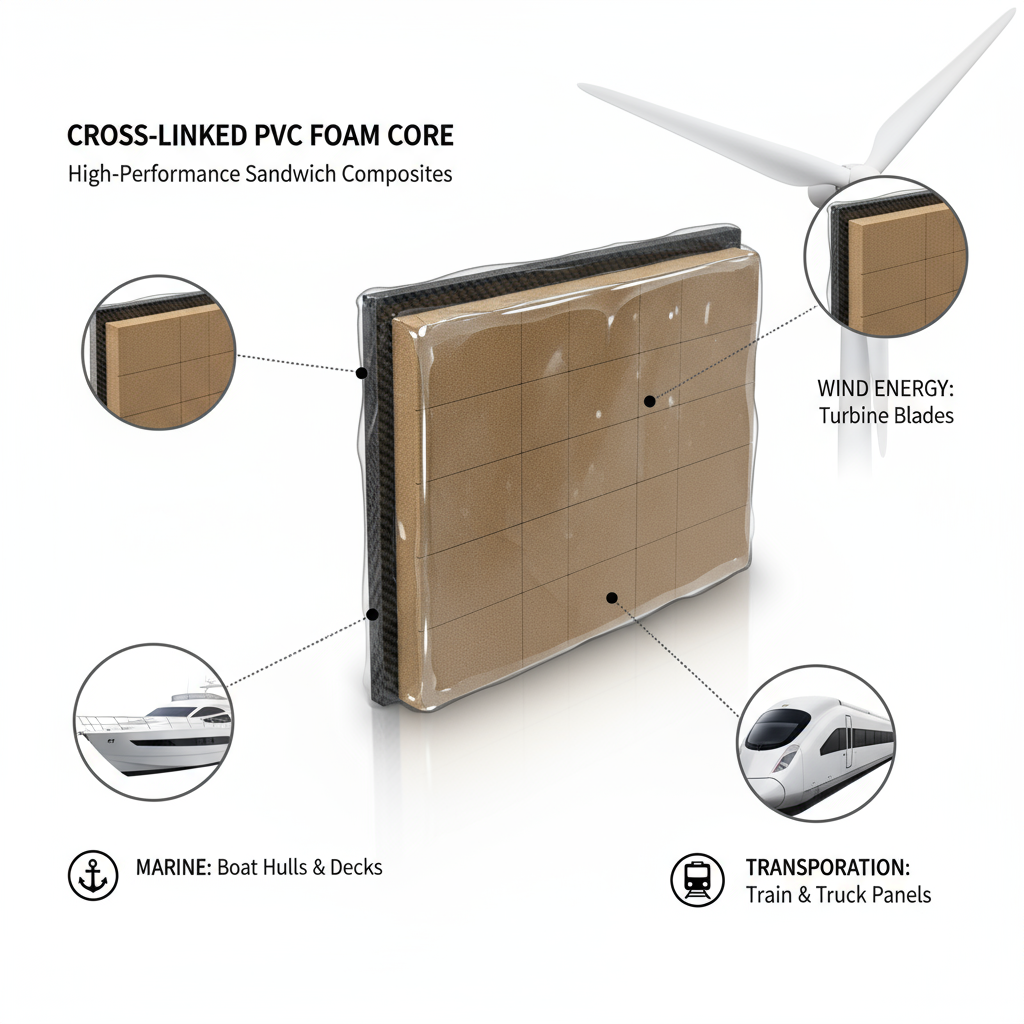
A cross-linked PVC foam core is the central layer in a "sandwich composite" panel. Imagine a sandwich: the two pieces of bread are strong, thin "skins" (like fiberglass, carbon fiber, or aluminum), and the filling is the thick, lightweight cross-linked PVC foam core. A cross-linked PVC foam core is a closed-cell, cross-linked PVC foam designed as the lightweight core in composite sandwich structures. It sits between skins (e.g., fiberglass, carbon, or aluminum) and provides:
· High specific stiffness and shear strength at low weight.
· Good fatigue performance and damage tolerance.
· Low water absorption due to closed cells.
· Compatibility with common resins (epoxy, vinyl ester, polyester) and film adhesives.
This structure works like an I-beam, creating a component that is exceptionally stiff and strong for its weight. The skins handle the tension and compression forces, while the foam core resists shear forces and keeps the skins stabilized. This is why cross-linked PVC foam core is a go-to material for demanding applications such as:
· Marine: Boat hulls, decks, and bulkheads.
· Wind Energy: The internal structure of wind turbine blades.
· Transportation: Panels for trucks, trains, and aircraft interiors.
· Industrial: Covers, tanks, and tooling.
Note: While cross-linked cores can be heat-formed to follow contours, they are not melt-reprocessable and should not be considered thermoplastic in processing terms. For optimal use, pair it with fiberglass or carbon fiber skins to create ultra-durable laminates.
For more details, please check <What is PVC FOAM CORE?>
Temperature and load
Crosslinked: better hot‑service and creep resistance; use when panels see warmth, sustained loads, or higher curing exotherms.
Linear: adequate for mild temperatures and intermittent loads.
Toughness vs stiffness
Linear: generally higher ductility and peel/impact energy absorption.
Crosslinked: higher stiffness and shear strength for a given density.
Processing and rework
Linear: thermoformable, weldable, easier to recycle mechanically.
Crosslinked: machine and bond; not remeltable; recycling typically down‑cycles to fillers.
Cost and availability
Both are widely available; crosslinked grades may carry a premium for performance.
It depends on the foam’s chemistry:
Linear (non-crosslinked) PVC foam → thermoplastic
Can be heat-formed and welded; more ductile and impact-friendly.
Common in signage boards and “linear” structural cores.
Crosslinked PVC foam → thermoset
Irreversible network; does not melt or flow on reheating.
Better hot‑service performance, creep resistance, and stiffness; typical for “crosslinked” structural cores.
Practical rule of thumb:
If it’s an expanded PVC sheet for signs/displays, it’s almost always thermoplastic.
If it’s a closed‑cell structural core for composites (marine, wind, rail), it’s often crosslinked (thermoset), though linear structural variants also exist.
1. Is PVC a thermoplastic or thermoset?
Thermoplastic. PVC chains soften/reform on heating (Tg ~80°C).
2. Is PVC foam thermoplastic or thermoset?
Both exist. Linear PVC foam is thermoplastic; crosslinked PVC foam is thermoset.
3. What about “PVC foam board” for signs?
Typically linear thermoplastic expanded PVC (often called expanded PVC sheet).
4. What is “crosslinked PVC” vs CPVC?
Crosslinked PVC is thermoset network (not melt-reprocessable). CPVC is chlorinated PVC and remains thermoplastic.
5. Does crosslinked PVC foam melt?
No. It may soften but will not melt or flow; excessive heat causes degradation.
6. Can I recycle PVC foam?
Linear yes—mechanically recycled/reprocessed. Crosslinked typically down-cycled as fillers; advanced routes emerging.
7. Can I bond PVC foam to composite skins?
Yes. Both linear and crosslinked bond well with epoxy, vinyl ester, polyester. Follow cure limits.
To bring it all together, let's summarize the answer in a clear table.
| Material | Type (or Behavior) | Why? |
|---|---|---|
| PVC (Polyvinyl Chloride) | Thermoplastic | Its polymer chains are not bonded together and can be repeatedly melted and reformed. |
| Standard PVC Foam | Thermoplastic | It's made from thermoplastic PVC and retains its ability to be softened by heat. |
| Cross-Linked PVC Foam | Thermoset | A chemical process creates permanent, irreversible bonds (cross-links) between the polymer chains. |
1. Standard PVC Foam: This is thermoplastic. It is the most common type used in everyday applications like signs and displays.
2. Cross-Linked PVC Foam: This is thermosetting. It is a high-performance material used in structural composites where superior strength and heat resistance are required.
Understanding this distinction is vital for selecting the right material for your project. For general-purpose fabrication, standard thermoplastic PVC foam is excellent. For high-stress, high-temperature, or critical structural applications, cross-linked thermoset PVC foam is the necessary and superior choice.
| Question | Answer | Key Reason |
|---|---|---|
| Is PVC thermosetting or thermoplastic? | Thermoplastic | Chains slide on heat. |
| Is Linear PVC Foam thermosetting or thermoplastic? | Thermoplastic | Retains PVC meltability. |
| Is Crosslinked PVC Foam thermosetting or thermoplastic? | Thermoset | Permanent cross-links. |
So, the next time someone asks if PVC foam is a thermoplastic or a thermoset, you can confidently say: "It depends! Standard foam is thermoplastic, but the high-performance cross-linked foam used in composites behaves like a thermoset." This knowledge is key to selecting the right material for your project and understanding its performance limits.

PVC is a thermoplastic polymer.
“PVC foam” is a family: linear foams (thermoplastic) and crosslinked foams (thermoset).
Crosslinked PVC foam core is the go‑to thermoset core for many sandwich composites due to its stiffness, heat resistance, and closed‑cell durability.
Choose linear PVC foam for ductility, ease of thermoforming, and recyclability; choose crosslinked PVC foam for higher hot‑service and structural efficiency.


